
_1.webp)


The final report of the Curriculum and assessment review led by Professor Becky Francis has been published. As the review states in its Executive Summary, “We must promote high aspirations and raise standards for the significant group of young people for whom the current system creates barriers.” The group facing the most significant barriers is boys, yet there is barely a specific mention of boys in the whole of the review.
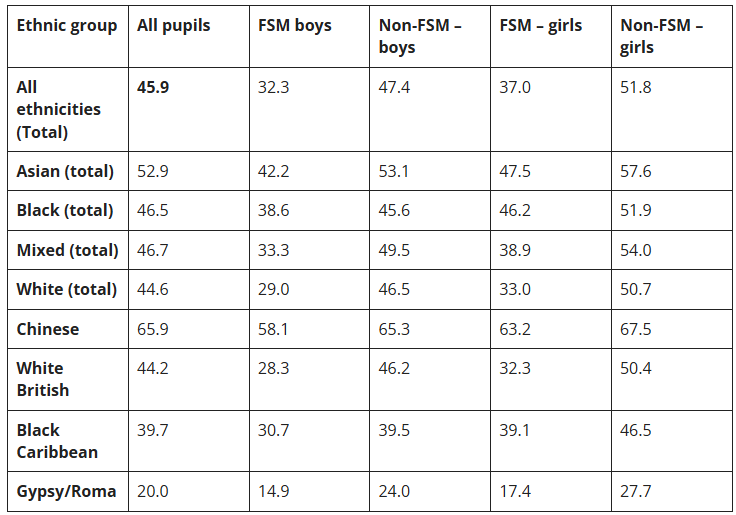
The data shows that white, working-class boys on free school meals (FSM) sit at the bottom of the educational attainment tables with just 29% reaching attainment 8 at Key Stage 4. Nor do black Caribbean boys on FSM do much better at 31%, while Gypsy/Roma boys on FSM prop everyone else up on 15%. The gap with girls from the same background is four percentage points, eight percentage points and 2.5 percentage points higher in each case.
Attainment 8 is a UK government measure1 that assesses secondary school performance by calculating the average score of a student's eight best GCSE grades at Key Stage 4 (normally students aged 16).
Table 1: Attainment 8 by ethnicity, FSM and gender (England, 2023/24)
Attainment 8 by ethnicity, FSM and gender (England, 2023/24)
Admittedly the review was of the curriculum not the whole education system. However not taking any sort of gender sensitive lens to reviewing what is, and what is not working, is a missed opportunity. It has been a full thirty years since boys’ attainment started to lag behind girls.’ And the review acknowledged the nature of the English Baccalaureate and its squeezing of time in the curriculum.
V levels may (or may not) be the answer to more choice at post 16, but by then it is often too late to undo the damage done by so many believing they cannot learn. The review also says the UK is an “outlier” with regard to how much is assessed at GCSE, yet emphatically rules out scrapping the examinations. Why? Do we need a form of matriculation at 16? It will still remain the case that many children will have had four rounds of mock exams before they sit the actual GCSEs.
It is to be welcomed that the review is explicit about creating more space in the teaching calendar for a wider range of subjects; for adding “life skills” more explicitly to the curriculum and adapting subject content to better reflect the AI revolution. It is also a good thing to do more on literacy and oracy in Year 7 as this will help many children achieve later on. But it would have been good to have had some nod to the fact that there is a difference between boys and girls in how they learn, what they like to learn, and why they want to learn what they want to learn.
The review represents tweaking and moderating rather than genuine reform. This government can do better and needs to do better for boys and many girls, too many of whom spend too long not learning but looking out the classroom window wishing they could pursue their real interests and desires.
Reference
1 Source: DfE, Key stage 4 performance – “National characteristics data” table, Average Attainment 8 by ethnicity, gender and FSM eligibility, 2023/24. (explore-education-statistics.service.gov.uk)


.png)