
_1.webp)

.png)

Why do so many boys not like homework?
OECD data shows that girls do more homework than boys across developed countries.
Do girls do better at GCSE than boys because they are doing more homework and revising more? Many’s the parent who has struggled to persuade their teenage son to do their homework, and asked them, “Why can’t you just get on with it like your sister?” It might come as a surprise to learn that across the developed world the same words can be heard in dozens of different languages.
The Boys’ Education Commission (BEC) wants to find out why.
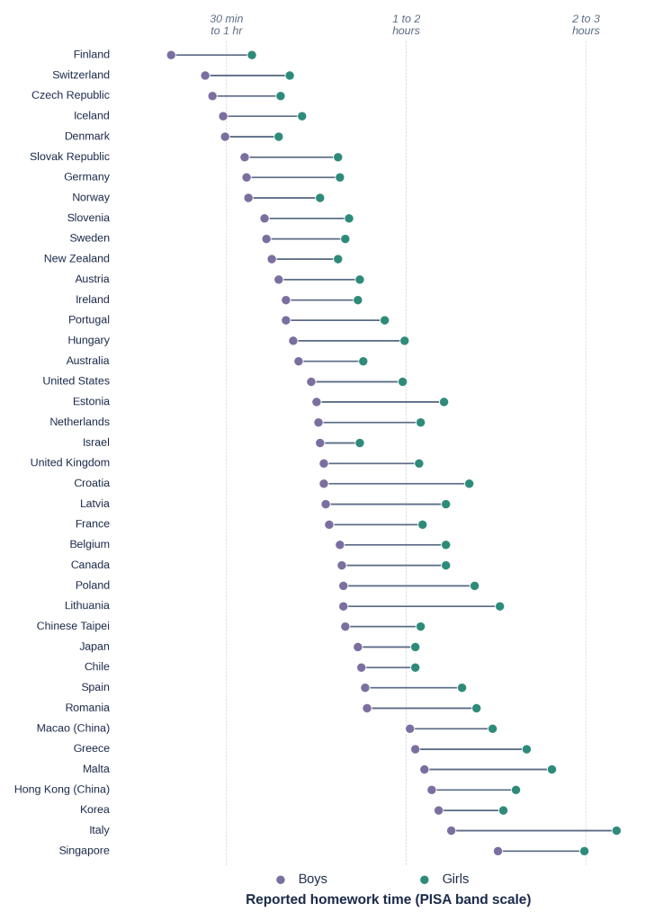
Analysis* conducted for the CPRMB by Research Fellow, Jordan Hill, shows that in an astonishing forty out of forty OECD countries referenced by PISA (Programme for International Student assessment), fifteen year old girls were spending more time on homework than their male counterparts, sometimes by hours a week. The size of the gap matters. The typical boy in a high-income country reports between 30 minutes and 1 hour of homework a day. The typical girl reports between 1 and 2 hours. In the UK, for example, boys report an average of about forty-five minutes per night while girls report doing their homework for just over an hour, on average.
Peter Hyman, chair of the Boys’ Education Commission says, “It’s one of those questions where it would be really easy to jump to conclusions and assume that boys are just lazier than girls, but we need to look more closely at what’s actually happening if we’re going to help boys catch up, because they’re currently being left behind at every level from early years to university. Do boys have more distractions? Are girls pushed harder? Or more focused? Is there something fundamental about the way both genders are treated in school that encourages girls to work harder but puts boys off? The Boys’ Education Commission intends to find out what is going on.”
Jordan says, “It doesn’t matter whether the country surveyed is in Europe, Asia or South America, the pattern is very much the same, regardless. The gaps between the time spent by boys and girls are smallest in places including Israel, Chile, Japan and Denmark, and widest in Lithuania and Italy, but the principle that girls spend longer on homework than boys is entirely consistent. These are self-reported figures, so they capture what students say they do, not what they actually do. The factors that may contribute include differences between boys' and girls' motivation and attitudes towards schoolwork, the expectations and support students meet at home, teachers' expectations and assessment practices, and even differences in physical health and emotional well-being. These are all being explored in a third report, which will be published as part of the International Literature Review on Boys’ Education in the coming months.”
The BEC is calling for evidence from educators, practitioners, schools, academy trusts, colleges, parents, students, researchers and other stakeholders to pin down precisely why boys are in difficulty and offer their insights, expertise and experience on ways to make things better. Anyone willing to give their opinions can do so by following the simple survey between now and 21st September.
The BEC is the most extensive research project to look at the reasons why boys, on average, are underperforming, relative to girls, in vital areas including literacy, attainment and engagement, as well as expressing deep dissatisfaction and resentment at their place in the world.
The CPRMB and the Boy’s Education Commissioners believe there needs to be greater visibility of the particular challenges boys face in education.
“This is about empowering boys to move forward alongside girls for everyone’s benefit,” Peter Says.
The need to sharpen the focus on boys’ education is evidenced by the latest figures for NEETs. The number of young men not in education, employment or training has now reached 553,000, the highest number for fourteen years. More key facts about boys’ educational attainment can be found on the Boys’ Education Commission website.
Chart Below:
*Reported total homework time in hours per day, by country and gender, on the PISA scale (age 15). High-income systems only (World Bank classification, Gulf states excluded). Descriptive cross-sectional pooling.
Source: OECD
For more details, please visit https://www.menandboys.org.uk/boys-education-commission

.jpg)