
_1.webp)

There has been a chorus of comment and policy announcements around youth unemployment and NEETs in the last few weeks. At last, the issue is rising up the agenda and as Alan Milburn said this morning on Radio 4’s Today programme “There are not many causes in British politics these days, but this has to be the top priority.” I agree. His review must be the catalyst for change.
Employment is a key focus area of CPRMB as is education, as is health, as is male identity. This is why the combination of addressing education and skills and the journey into male youth unemployment and becoming a NEET are among the most important concerns we are addressing. This is one of the reasons why CPRMB is hosting the Boys’ Education Commission.
Today’s landmark Government commissioned report by Alan Milburn, Young People at Work, has some stark figures:
· The number of NEETs is due to rise to 1.25 million from 1 million
· 84% of young people who are a NEET want to work
· The UK’s NEET population rate is increasing, but in countries such as Holland and Ireland, the opposite is true.
The new figures for NEETs and wider male unemployment show the highest levels and rates for 14years.
Over the next week, CPRMB will be exploring the range of recent reports and comments (listed below) to try to distil from them some suggested causes and proffered solutions.
It is vital that these are examined through a gender-sensitive lens. The fact that economic inactivity for male NEETS surpassed unemployment in 2018 is a little explored issue.
There is starting to be some recognition of the status of male NEETs with the BBC acknowledging “Young men not in work or education are driving the NEET rise”.
The Milburn Review only mentions male NEETS in passing, saying, “The reasons for the rise in NEET rates specifically for men are complex, but more health issues, the erosion of traditional employment routes, and a growing gap in educational outcomes are likely to be contributing factors, although the evidence on relative impact remains limited.”
That is the just the first part of the policy journey…recognising the actual data. The next are being concerned and then acting.
Our work at CPRMB aims to cover all three bases in the policy and research field…and greatly accelerate the pace of change.
Male NEET Trends
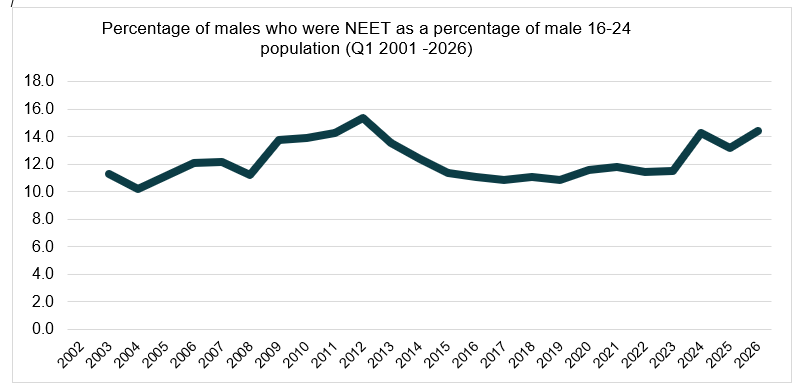
Looking at today’s male NEET Q1 2026 figures, the trends remain of great concern.
Figure 1: Numbers of Male NEETS (thousands, Q1 2002 - 2026, aged 16-24)

Figure 2: Percentage of males who were NEET as a percentage of male 16-24 population (Q1 2001 -2026)
Overall Numbers
- The number of male NEETs (553,000) is at a 14-year high (570,000 in 2012).
- The percentage (14.4%) is also at a 14-year high (15.2% in 2012)· .
Unemployment
- The number of young men who are unemployed NEETS (257,000) is at an 11-year high (257,000 in 2015).
- The unemployment rate of 6.7% is also at an 11-year high (6.9% in 2015).
- The number of unemployed NEET young men far outstrips the number of NEET young women (143,000). The gap of 113,000 is the largest since 2014.
Economically Inactive Rates
- The number of economically inactive male NEETS (297,000) has gone back up from 269,000 in 2025. The previous high was in 2024 (314,000).
- The economic inactivity rate of 7.8% is trending up again from 8.4% in 2024 and 7.1% in 2025.
What is striking in the economic inactivity rates is:
- The economic inactivity rate and numbers for young male NEETS overtook the unemployment rates and numbers in 2018.
- The economic inactivity rate is double now (7.8% in 2026) than when the records were first collected (3.9% in 2002).
Male Unemployment
Adding to this are last week’s unemployment figures (Jan to Mar 2026) which showed an alarming picture for men overall:
- 960,000 working age men are unemployed which is 131,000 more than the same time in 2025. It is the highest Q1 number since 2014.
- The male working age unemployment rate had reached 5.4%, the highest Q1 rate since 2015.
- The number of unemployed young men (18-24) had reached 365,000 at a rate of 17.3% (one in six young men). It is the highest rate and number since 2014.·
Notes: Recent Research and Comment
There have been recent reports and interventions on NEETs:
- Peter Hyman report: Inside the Mind of a Young Neet
- John Boumphrey (CEO, Amazon UK): BBC
- Lord Wolfson (CEO, NEXT): Guardian
- Youth Futures Foundation: Research into NEET indicators
- National Centre for Economic Research: What drives young people to experience NEET
- Institute for Fiscal Studies: Why has the NEET rate risen?
- Department for Education: Risk factors for becoming NEET
- Policy Connect: 'Earning or Learning: A New Agenda for Youth NEET Reduction'
- Loss of Manual damaging men: Sting in The Guardian