
_1.webp)


Stemming from research and evidence provided by experts in male suicide prevention, a Parliamentary report highlighted three drivers for male suicide ideation. These were broadly Life Issues (external stressors), Universal Issues and Transitional issues. The former including unemployment and financial strain; the middle including loss of identity and purpose; the latter including sudden transitional points such as redundancy and loss of work – especially if unexpected.
Research published in 2013 from the universities of Bristol, Oxford and Hong Kong, said “researchers are suggesting that the 2008 global economic crisis could be to blame for the increase in suicide rates in European and American countries, particularly among males and in countries with higher levels of job losses.” The word “could” is based on the lack of explicit evidence of causation albeit there seems to be a correlation.
Given the economic history of the UK over the last 45 years, there have been four economic recessions (where growth in Gross Domestic Product is less than zero for two consecutive quarters). These were in:
- 1980-81 (high interest rates/high inflation and government policy)
- 1991 (high interest rates to curb inflation from the 1980s credit boom)
- 2008-09 (financial services crash)
- 2020 (impact Covid-19 but low growth since the immediate bounce back).
Mapping the GDP rates and unemployment rates since 1981 (these are UK figures) and the male suicide rates (these are for England and Wales), a few patterns emerge.
Figure 1: GDP growth (UK), male unemployment rates (UK) and male suicide rates (England and Wales, 1981-2024)
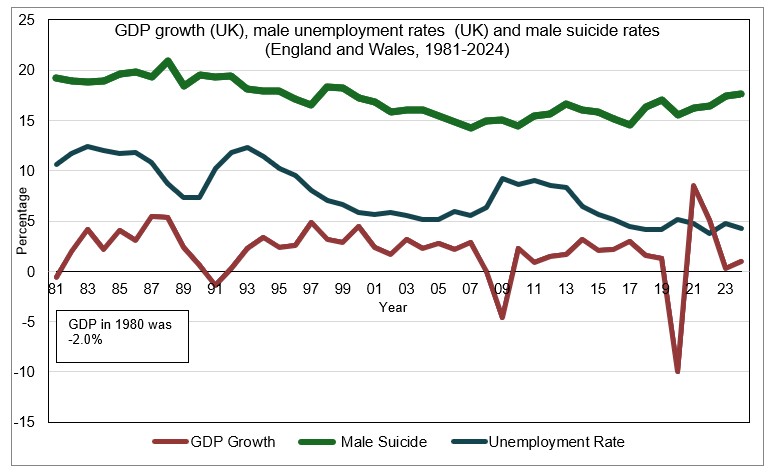
In the first recession (1980-81), unemployment went up two years after the recession ended. There was no discernible change in suicide rates until three years later (1985-1988), albeit these were at record highs. Unemployment became entrenched in the post-industrial towns with the collapse of mining and heavy industry.
Male suicide rates in England and Wales are at the highest on record in the 1980s and early 90s (1988 is the highest on record at 20.7 per 100,000) even higher than now (with the exception of Wales where it is currently the highest ever.)
In the second recession (1991), again unemployment went up two years after the end of the recession but there was no increase in suicide. In fact, suicide rates started to fall. This recession was short and sharp, and was followed by a period of high GDP growth.
The third recession (2008-9) as shown in the research cited above, the suicide rate started to increase again in the two years after the end of the recession. In 2007, the suicide rate was 14.2 per 100,000 and by 2013 it had gone up to 16.6 per 100,000. It started to fall again as unemployment started to fall.
Looking at the Covid recession, suicide rates have been increasing and are at the highest rate this century (17.6 per 100,000 in 2024). Immediately after the recession in 2020 (GDP fell by 10%), the economy bounced back with growth rates of 8.5% (2021) and 5.1% (2022) but has “flatlined” with growth rates of 0.3% (2023) and 1% (2024). It was 1.4% in 2025.
In addition, the pandemic has seen a reported increase in mental health conditions.
It is important to note, however, that male suicide rates were creeping back up in the immediate pre-Covid period and had reached 17.0 per 100,000 in 2019.
Conclusion
For the first recession (1980-1981), third recession (2008-2009) and the latter recession (2020), there seems to be an increase in the male suicide rates a few years after the end of the recessions. There is also a corresponding two-year lag in increases in unemployment rates in the first and fourth recessions.
The evidence shows that there is a potential pattern between economic downturns and increasing unemployment on male suicide rates in the years following the economic ‘event’.
This is a correlation and not necessarily proof of causation as the pattern is not consistent. However, it may be that unemployment is an exacerbating and cumulative factor for some men with respect to suicide ideation.
Many men found it hard to find work after the third recession and this recession was unpredicted and deep (average growth was c 2.5% in the years before and then in 2009 it fell by 4.6%). The same was true for many men in the first recession and some communities have never recovered.
In 2025, the economy flirted with going into recession yet did grow and unemployment at 5.3% is the highest since 2015. An increase in the suicide rate in 2025 (figures will not be available until late autumn) will give a clearer indication of an overall correlation in economic growth and unemployment. But this may be overlaid with the long-term mental health impacts of the pandemic.
As ever, more research is determine whether there is a causation with respect to male suicide and whether particular types of men are most vulnerable. However, it suggests there can be a correlation when there are other factors such as deindustrialisation, sudden economic shocks and wider issues such as the mental health impacts of a pandemic.
This is a part of a series of health related research snapshots for Men's Health Week #MensHealthWeek

.jpg)