
_1.webp)


It’s National Apprenticeship Week (NAW2026), a “week-long celebration that brings together businesses and apprentices across the country to shine a light on the positive impact that apprenticeships make to individuals, businesses and the wider economy.”
Recently published figures by the Department for Education[i] show a concerning fall in young men starting and finishing apprenticeships.
Key Summary
There has been a decline in the number of young men (24 and under) starting an apprenticeship (29,300) and achieving an apprenticeship (25,000) between 2017/18 and 2024/25.
This fall should be recognised and reversed through government and regional employment, education and skills policies. This includes the application of a gender-sensitive lens to find out if there are different gendered reasons for these falls for both young men and young women.
There has been an increase in the number of men(25+) starting an apprenticeship meaning an increasing proportion of apprenticeships are taken up by this age group - from 34% in 2017/18 to 41% in 2024/25.
Apprenticeship Starts
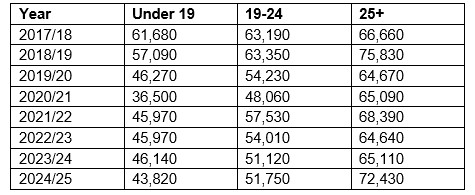
- In 2024-25, 17,860 fewer under-19 males and 11,440 fewer 18-24 year old males started an apprenticeship than in 2017/18 to 2024/25. This is 29,300 fewer apprenticeships within the NEET age group.
- This is a fall of 29% and 18% respectively, while there has been an 8% increase in 25 and over males starting apprenticeships.
- Between 2017/18 and 2024/25, the proportion of overall apprenticeships started by under-19 males has fallen from 32% to 26%. For 18-24 year olds it has fallen from 32% to 30%. For 25 year olds, it has increased from 34% to 41%.
This means a clear decline in young men starting apprenticeships while there has been an increase in men (25+) starting them. The latter may be due to companies converting training into apprenticeships as a means of spending their apprenticeship levy.
Table 1: Number of male apprenticeship starts by age (UK)
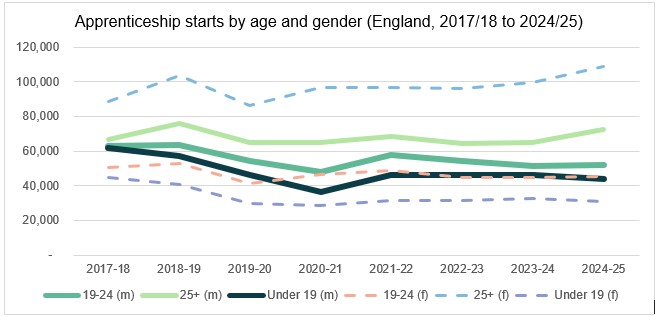
The figure below shows the gender differences and the pattern is similar for women.
Figure 1: Apprenticeship starts by age and gender (England, 2017/18 to 2024/25)
Apprenticeship Achievements
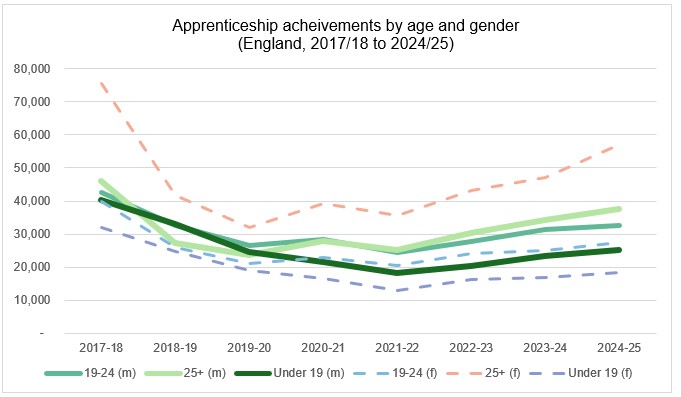
The DfE figures for apprentice achievements also range from 2017/18 through to 2024/25. They also show three key trends:
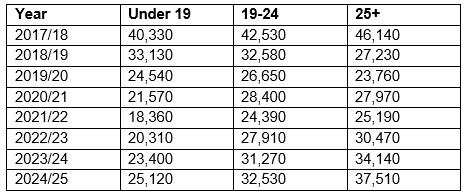
- In 2024/25, 15,210 fewer under-19 males and 10,000 fewer 18-24 year old males finished an apprenticeship than in 2017/18. This is 25,000 fewer within the NEET age group.
- This is a fall of 37% and 24% respectively, while there has been an 18% increase in 25 and over males finishing apprenticeships.
- Between 2017/18 and 2024/25, the proportion of overall apprenticeships achieved by under-19 males has fallen from 31% to 26%. For 18-24 year olds it has increased from 33% to 34%. For 25 year olds, it has increased from 36% to 39%.
This means a clear decline in the numbers of young men achieving apprenticeships.
Table 2: Number of male achievements by age (UK)
The figure below shows the gender differences and the pattern is similar for women.
Figure 2: Apprenticeship achievements by age and gender (England, 2017/18 to 2024/25)
[i]Department for Education, Apprenticeships 2024/25, 2025: https://explore-education-statistics.service.gov.uk/find-statistics/apprenticeships/2024-25