

Milburn Review
The Milburn Review was launched this week with a range of key policy announcements. In the NEETs data, there are similarities between young men and women but clear differences too.
We have seen the number of young men who are economically inactive overtake those who are unemployed. Far more young men than young women are unemployed and far fewer are inactive due to looking after their family and home.
Alongside increasing the opportunities for work experience and entry-level job creation in every postcode, our emerging research shows the need to invest in vocational education and to ensure it is seen as a true equal to higher education.
This is becoming even more important as there is a clear non-alignment in parts of the economy. On the one hand we have hundreds of thousands of young men who are unemployed or economically inactive, yet we also have large numbers of vacancies in health, social care and education. It is why we have strongly advocated for focused promotional campaigns such as “This Boys Cares” to encourage more young men into these roles.
The fact we also have vacancies in construction and logistics roles too shows how we need to take a more structural whole economic, skills and educational system approach alongside many of the proposals put forward in the important report today.
CPRMB particularly welcomes the recommendation to create a huge expansion in post-18 college places, with an extra 150,000 18- to 24-year-olds taking up a further education place. The Youth Opportunity Service must be a local service. Regional mayors should work with local employers to develop new industry-led technical colleges or specialist campuses and the more local and regional the implementation the more nuanced and better fitted to local opportunities it should be.
However, thought needs to go into how to recruit skilled tradespeople into the teaching of those skills in colleges. Recruitment of well-trained staff into vocational areas is a real Achilles heel for any plans to expand FE.
Employers being given financial incentives for taking on Neets is another recommendation that could benefit many. A young person who has been inactive for six months could come with a £3,000 payment, while an additional £2,000 could be offered if the young person has been in care or is disabled. CPRMB would strongly support these measures being introduced.
CPRMB would recommend the government applying a gender lens to all the recommendations given the asymmetries in work and education readiness between young women and young men.
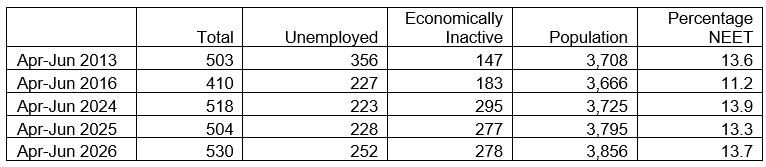
The latest ONS figures (in thousands) for male NEETs are outlined below.
These show:
- Male NEET rates have started to increase again for both categories (Unemployed and Economically Inactive).
- The rates are at the highest for broadly 13 years and higher than ten years ago.
- The graph below also shows that the numbers of male NEETS who were unemployed as opposed to economically inactive switched over in 2018 when more male NEETS became economically inactive than were unemployed, and so further from the labour market.
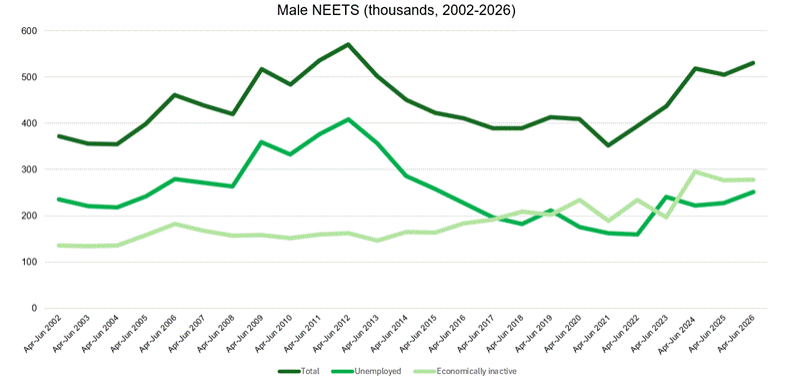
There is a different pattern between male and female NEETs as the tables for April to June 2026 below show (figures in thousands):

This can also be seen greater detail a Department for Education annual report for figures covering 2025.
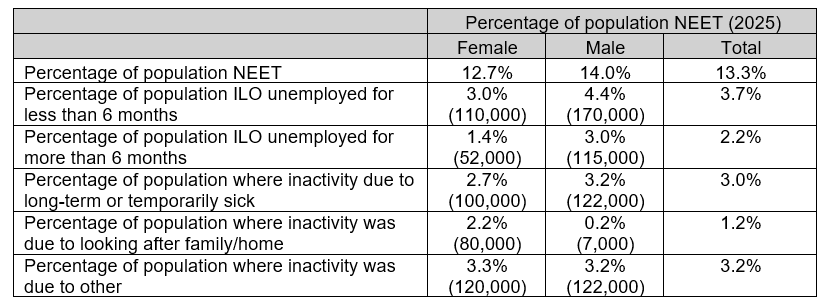
These show that the number of long-term unemployed male NEETS is double tha female NEETS.
In addition, there is a difference with regard to family and home – with ten times as many female NEETs with these responsibilities.