
_1.webp)


Key Summary
Based on the new employment figures published this month:
(1) Male unemployment is rising and is now at 5.5% (July to September 2025) and nearly a million men are unemployed (968,000). There are 181,000 more unemployed men than a year ago.
(2) The employment rate is unmoved and there remains a need to ensure 1 million more men are in work to reach the Government’s overall employment rate target of 80%.
(3) The number of working age men who are long-term sick is highest number on record (figures go back to 1992) - 1.338 million.
(4) The number of economically inactive young men (currently 269,000) overtook unemployed young men in Jan-Mar 2018 and has continued to be higher ever since. New NEET figures are due in 20 November 2025.
(5) The Government has launched two important reports in the past fortnight and each must take a gendered lens to the challenges of unemployment and employability – to understand and address specific issues that are holding men and women back which may be due to their gender.
- Independent investigation to be launched to tackle rising youth inactivity (10 November 2025): https://www.gov.uk/government/news/independent-investigation-to-be-launched-to-tackle-rising-youth-inactivity
- Keep Britain Working (5 November 2025): https://www.gov.uk/government/publications/keep-britain-working-review-final-report/keep-britain-working-final-report
Unemployment Rate
The unemployment rate is 5.5%, the highest since the middle of the pandemic (5.6% in November 2020 to February 2021). It is higher than the recent 3.8% rate in June to August 2022.
For July to September 2024, the rate was 4.6% and for July to September 2015 (ten years ago) it was 5.6%. In the pre-pandemic period for July to September 2019, the unemployment rate was 4.2%.
The figures, not withstanding the pandemic period, are back to where they were ten years and are worse than the pre-pandemic period.
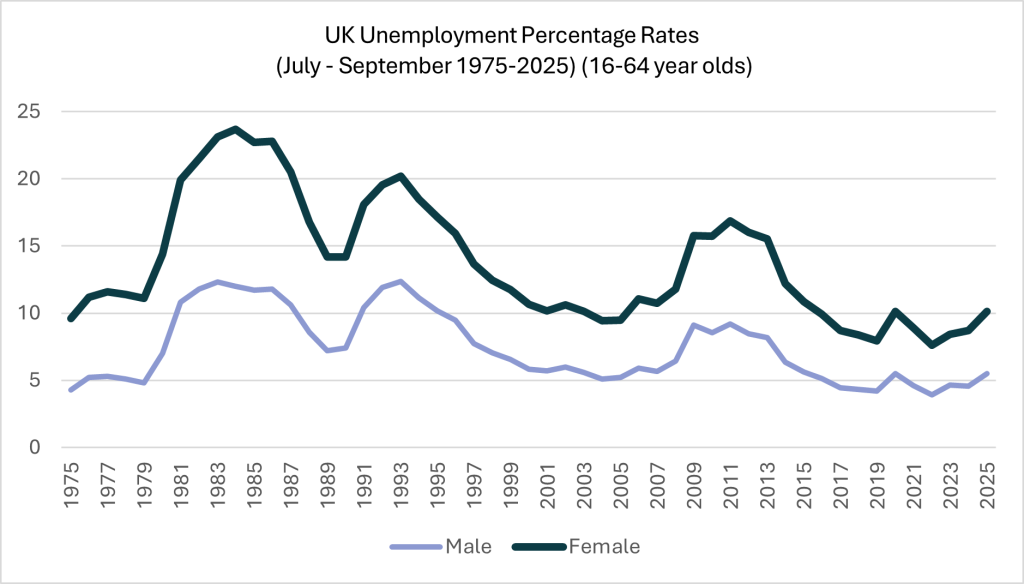
Data Source: Office for National Statistics (Labour Force Survey), Unemployment rate: UK: Male: Aged 16-64: %: SA
Unemployment Numbers
The unemployment numbers are increasing with 968,000 men now unemployed for the July to September 2025 period. This is the highest number since May to July 2015 (970,000).
A year ago, the figure was 787,0000 so there has been an increase in male unemployment of 181,000.

Data Source: Office for National Statistics (Labour Force Survey), Unemployed: UK: Male: Aged 16-64: Thousands: SA:
Employment Rate
The current male employment rate is 77.4%, the same as a year ago (July to-September 2024). However, this is lower than ten years (78.6%) and lower than in the pre-pandemic period (July-September 2019 when it was 80.2%).
In the CPRMB Missing Men report (May 2025), it was an estimated that to reach the Government’s overall target of an 80% employment rate, it would mean a male employment rate of 83% was needed, assuming that the gap in employment rates between men and women remains at the 6% difference seen since the pandemic. This would mean almost a million (975,000) more men in work.
Economic Inactivity and Sickness
The latest figures (July or September 2025) show that there are 3.79 million (16-64 year old men) men who are economically inactive. Many are students (1.1 million) and retired people (479,000), however, however, 1.338 million are long-term sick and 92,000 temporary sick. In addition, 949,000 want a job which is 25% of all those who economically inactive.
The number of working age men who are long-term sick is highest number on record (figures go back to 1992).
Whilst there is a fall in overall economically inactive figures since the same period in 2024 (3.929 million) this is largely driven by a fall in male student numbers (94,000 fall). The long-term sick number increased by 29,000 and those wanting work in 2024 was 68,000 fewer.
There has been a significant increase in long-term sickness for working age men. In the pre-pandemic period (July to September 2019), there were 958,000 men. So the increase has been an extra 380,000 men in that period. In July to September 2015, the figure was 1.037 million.
Data Source: Office for National Statistics (Labour Force Survey, A02 SA: Employment, unemployment and economic inactivity: http://bit.ly/43WhGDq
NEETS
The latest figures cover July to September 2025 and were published on 20 November 2025:
(1) The number of economically inactive young men (currently 274,00) overtook unemployed young men in July-Sep 2017 and has broadly been higher ever since.
(2) The number of unemployed young men is 238,000.
(3) 13.4% (one in seven) young men are a NEET.
The ONS has set out that it has reset its NEETS calculation method, hence potential differences in previous reports.
Data Source: Office for National Statistics, Labour Force Survey, Young people not in education, employment or training (NEET), UK: November 2025