
_1.webp)

Missing Men Business Scorecard Report
Summary Key Facts and Messaging
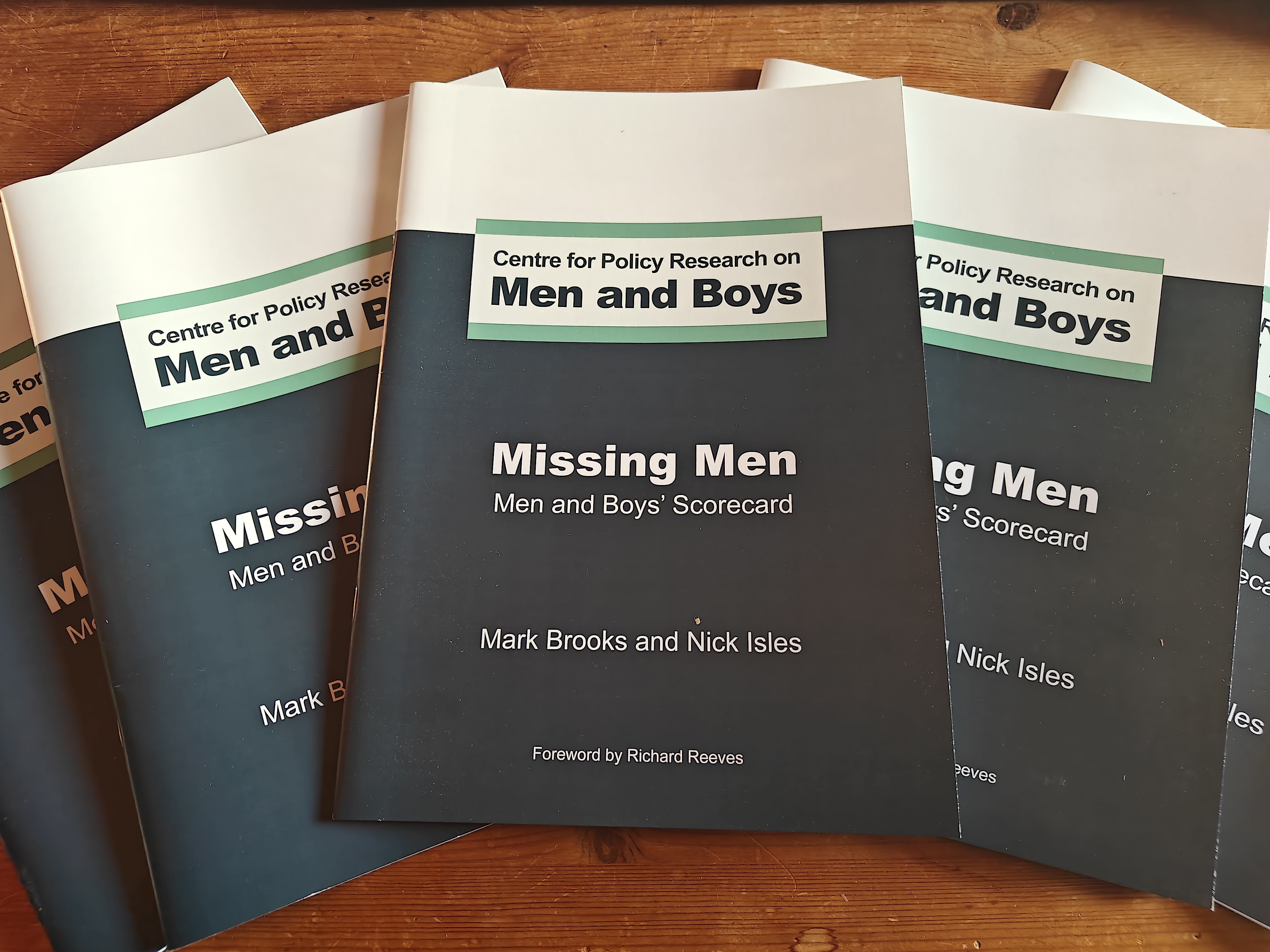
While there has been post-pandemic progress in areas such as education (albeit a gender attainment gap still persists), recent figures on employment, suicide and crime have not “recovered.” These have been featured in the CPRMB report (Missing Men Business Scorecard).
The national level messaging and narrative (including the political message) has changed since Netflix’s Adolescence due to evidence-based research from the Centre for Social Justice’s Lost Boys Report, this think-tank’s Missing Men Report and also recent research from YouGov and Demos. Speeches from Sir Gareth Southgate on mentoring and the Lost Boys Taskforce have really helped too. The narrative has changed from “The problems (young men) and boys cause” to” The problems (young) men and boys have – and now we do something to help them.”
There remains a need to accelerate policy action. The forthcoming Men’s Health Strategy sets the gold standard in taking a gender-specific lens to these problems and solutions. In terms of policy, high level asks are:
- National strategy on understanding and addressing the gender education attainment gap.
- National strategy and/or taskforce specifically on addressing male suicide.
- All employment strategies including the newly announced review on youth inactivity should look at any gender-dimension to the barriers men face. We need more men over 50 back in work as well as younger men getting into work. Plus, we need more men working in health, education and social care roles.
- Greater investment into youth clubs, mentoring and associated activities for young men including more investment in diverting boys in danger of entering the criminal justice system
- Ofcom should create guidance for tech companies on online harms affecting (young) men and boys. They are developing guidance for women and girls (good) but refuse to for men and boys.
- Consider a strategy focused on male victims of sexual harm, domestic abuse, stalking and forced marriage (currently this sits within the Violence Against Women and Girls Strategy).
- Support on extending paternity pay and leave – as put forward by groups such as The Fatherhood Institute, Parenting Out Loud and The Dad Shift.
Key Facts
Health and Suicide
- One in five men do not live to 65.
- On average, c12,000 men die from prostate cancer every year. This is 33 per day and one every 45 minutes.
- In 2014, 14 men die every day by suicide in the UK (three in every four) with a suicide rate increasing for the past four years. The suicide rate in England and Wales combined is the highest this century. More than 5,000 UK men take their own lives and Wembley Stadium could be filled with the number of men (95,255) in England and Wales who have died by suicide this century.
- In 2023, 6,983 men died in the UK specifically due to alcohol (19 per day), compared to 5,019 (14 per day) in 2019.
- 87 men every day in England die from cancer.
- 72 men under 75 die every day in England from cardio-vascular disease.
- In England, the lowest male life expectancy across local areas was in Blackpool (73.1 years); the highest life expectancy was in Hart in Hampshire (83.4 years).
Education
- Boys are behind girls at every stage – from reception year to university entry.
- Only 60.7% of boys are school-ready when first enrolled compared to 75% of girls
- GCSEs: 43.7% of boys (46.7% girls) achieved Grade 5 (strong pass) in English and Maths in 2024/25. 67.5% of GCSEs (2024/25) taken by boys achieved a grade C/4 and above – 73.% girls. White British, Black Caribbean and Gypsy Roma working class (free school meals) boys fare the worst.
- A levels: 76.7% of A levels (2024/25) taken by boys achieved a grade C or above – 80.4% girls. Boys take fewer A levels, so 59,000 fewer grade C or above A levels were awarded to boys than to girls.
- University: In 2025, 45,000 fewer UK males aged 19 and under went to university than their female peers.
- Exclusions: 7,695 boys (3,190 girls) in England were excluded from school in 2023/24
- Apprenticeships: English males aged 19 and under make up 58% of apprenticeships.
Employment
- The latest NEET figures (16-24 year olds) show that for the UK in April to June 2025: 224,000 young men were unemployed; 273,000 were economically inactive; young men make up 62% of young people who are unemployed. Up until 2018, the male NEET unemployment rate was higher than economic inactivity – since then it has switched.
- Male unemployment is rising and is now at 5.5% (July to September 2025) and nearly a million men are unemployed (968,000). There are 181,000 more unemployed men than a year ago.
- The number of working age men who are long-term sick is the highest number on record, 1.338 million are long-term sick and 92,000 temporarily sick. In addition, 949,000 want a job which is 25% of all those who are economically inactive.
- The UK construction industry has 140,000 job vacancies and social care has 110,00 vacancies.
- Only 25% of teachers are male (2,200 vacancies), c40% of GPs are male and men make up just 11% of nurses.
Rough Sleeping
- The number of men sleeping rough in England has increased – and is at its highest since 2017. 3,214 men were found to be sleeping rough in Autumn 2024 in England. Men make up at least 83% of rough sleepers.
Criminal Justice
- There are over 90,000 men in prison– enough to fill Wembley Stadium. They make up 96% of the prison population.
- There are 480 young men in youth custody (15 young women).
- More than 400 men are victims of homicide in England and Wales every year.
- 2 million men are victims of sexual assault, domestic abuse or stalking every year - all are classed in official statistics as being victims of violence against women and girls.
Provided by Mark Brooks, Director of Policy, Centre for Policy Research on Men and Boys (CPRMB)
Mark@menandboys.org.uk / 07834 452357 / www.menandboys.org.uk
CPRMB is a registered charity in England and Wales(5260351)