
_1.webp)


We Need to support male university students in the right ways: Why male-specific spaces are key to suicide prevention
The data surrounding student mental health in the UK highlights a clear and persistent gap between the experiences of men and women. Although universities have invested heavily in expanding their wellbeing services, young men are still not seeing the same positive outcomes as their female peers. This suggests that while general support is available, there is a vital need for more targeted and innovative approaches. By creating support specifically designed for men, we can better reach those who currently feel the existing systems do not speak to them or meet their needs.
Recent figures from the Office for National Statistics (2025) reveal the scale of this challenge: the suicide rate for male students in England and Wales stands at 10.4 per 100,000, more than double the rate for females (4.3 per 100,000). As the National Review of Higher Education Student Suicide Deaths (2025) highlighted, male students account for more than 70% of suspected suicides in the sector. These figures invite us to look closer at the specific pressures that define the university experience for young men. Far from being a sudden or unexplainable crisis, the data shows that these tragedies often cluster around predictable periods of high stress.
For many students, the weight of academic expectations becomes most acute during transition points, such as the beginning of a new term or the start of a placement. The pressure of impending or missed assignment deadlines, as well as the arrival of exam seasons, including the high-stakes environment of resits, frequently served as critical points of distress. Even the moments following these milestones, such as receiving recent exam or assignment results, carried a significant emotional burden. When combined with wider personal or financial worries, these academic milestones can create an overwhelming sense of loneliness and isolation. By recognising these specific triggers, we are better equipped to design support systems that feel relevant, timely, and truly welcoming to the male student experience.
Moving Beyond Traditional Support
Standard university mental health support often follows a clinical model requiring students in distress to recognise a problem and book formal, face-to-face appointments. For many men this environment can feel quite intimidating and overly “medicalised”. Recent research (Shepherd et al., 2025) suggests that many men hesitate to share their feelings in these professional settings. To address this, we can look toward community-based social networks that allow men to reconnect without the pressure of a formal "help-seeking" environment.
MenGage: A Blueprint for Connection
The work of MenGage (pseudonym), a grassroots charity recently highlighted in the Journal of Prevention & Intervention in the Community (Shepherd et.al. 2025),offers a practical blueprint for how we can better support male university students. Its approach is built on a simple but powerful principle: men are often very willing to talk, provided the environment feels natural rather than clinical. By bringing support directly into the rhythm of everyday public activity, they have created a model that feels less like "treatment" and more like community.
This journey of connection often begins in the digital world, where a private app allows men to introduce themselves and build a sense of belonging before they ever meet face-to-face. This helps bridge the gap between a lonely digital existence and the warmth of real-world friendship.
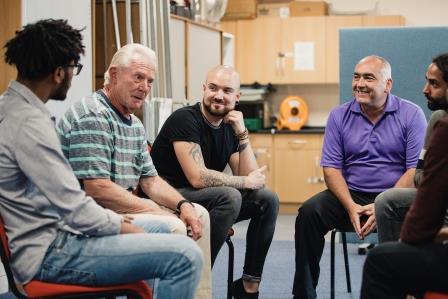
When members do meet in person, they don’t gather in professional offices; instead, they meet in the familiar public spaces where they already feel at home. You might find a group sharing breakfast in a village hall or gathering at a local sports stadium to chat. These "familiar spaces" are vital; research shows that when men are in a comfortable, everyday setting, they find it much easier to lower their guard and move past the societal expectation to always remain "tough" or silent.
The interaction itself is often centred around a shared interests, such as social football or video game groups in local venues. This creates what is known as "side-by-side" interaction. Rather than the intensity of eye-to-eye questioning, men can focus on the game or the activity, which naturally lowers their barriers to conversation. In these moments, between the goals or during the game, men tend to find they can speak more openly and naturally about their lives and mental wellbeing.
Normalising Wellbeing
Evidence from the Student Minds (2025) best practice guide shows that supporting male mental health is most effective when we move away from clinical jargon in favour of everyday language and the promotion of "positive masculinity." This research underlines the importance of the community approach adopted by MenGage, suggesting that looking after one’s mental health should be presented as a vital part of being a resilient and successful student rather than a specialised medical process.
To lower the rates of male student suicide, the higher education sector should consider developing its own community groups, potentially in partnership with Students’ Unions as hubs of familiar connection. By investing in these spaces, where mental wellbeing is fostered through sports, hobbies, and peer support, universities can translate research evidence into effective mental health support. This shift creates a more inclusive, less isolated environment that meets male students where they are, rather than waiting for them to seek out traditional and often ill-fitting mental health services.
References
Department for Education. (2025) National review of higher education student suicide deaths, [Accessed January 2026] .https://www.gov.uk/government/publications/national-review-of-higher-education-student-suicide-deaths
Office for National Statistics. (2025). Estimating suicide among higher education students, England and Wales: August 2016 to July2023, [Accessed January 2026]. https://www.ons.gov.uk/peoplepopulationandcommunity/birthsdeathsandmarriages/deaths/articles/estimatingsuicideamonghighereducationstudentsenglandandwalesexperimentalstatistics/august2016tojuly2023
Shepherd, G., Murphy, H., Woodhams, J.,& Watling, S. (2025). Using public spaces for male community mental health support. Journal of Prevention & Intervention in the Community,1-17. https://doi.org/10.1080/10852352.2025.2558388
Student Minds. (2025). Supporting Male Student Mental Health in Higher Education: A Best Practice Guide.[Accessed January 2026]. https://hub.studentminds.org.uk/wp-content/uploads/2025/02/supporting_male_student_mental_health_in_higher_education.pdf